KLOW peptide: checking the transmission
Gut cells, cut rat tendons, copper and a shortened protein: the KLOW story changes considerably on the journey to a screen.

KPV and the inflamed gut
KLOW peptide sounds like a single subject. Its research sends back several different messages. KPV, GHK-Cu, BPC-157 and TB-500 share a vial, while the experiments behind them used different compounds, routes and subjects. No controlled trial has tested the full blend.
I start with KPV because its gut work has a satisfying specificity. In Dalmasso’s cell and mouse experiments, a transporter called PepT1 carried KPV into intestinal cells; inflammatory signalling fell, and mice with colitis had milder disease. A transporter is a protein that carries a substance across a cell’s boundary. Getting a peptide to its destination was part of the experiment’s success.
That makes the later leap to a general repair blend especially interesting. The destination, the way of getting there and the other ingredients have all changed. Delivery deserves a larger share of this argument, to my mind. The later KPV delivery work makes that question more concrete.
What does the KLOW vial contain, and who offers it?
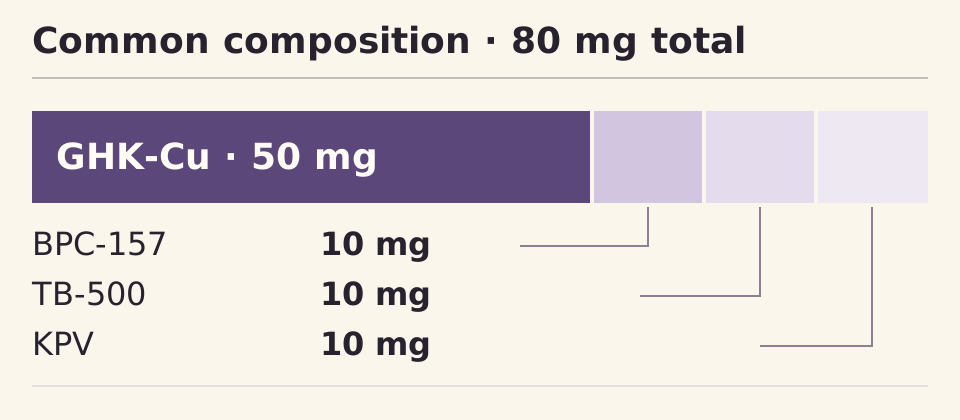
The KLOW peptide blend is a co-formulation: four chemically distinct research peptides co-dissolved at fixed ratios in a single lyophilized vial. The most widely listed research composition across independent compounders is 80 mg total — GHK-Cu 50 mg, BPC-157 10 mg, TB-500 10 mg, and KPV 10 mg. The peptides remain separate molecules; they do not react to form a new compound.
The name KLOW is a reverse acronym: K for KPV, L-O for GHK-Cu's tri-letter sequence's copper carrier (conventionally rendered as the middle two), W for the Wolverine-lineage TB-500 and BPC-157 pairing. Whatever the naming rationale, the substance is four peptides — not one. That structural fact governs how every finding in this dossier should be read.
KLOW is distinct from the GLOW blend, which contains GHK-Cu, BPC-157, and TB-500 but not KPV. The KPV arm is what separates the two stacks and is the editorial through-line of this dossier. The dealt research lens here is anti-inflammatory: the KPV literature leads, and the other three arms are read in relation to it.
Two channels currently carry this four-peptide composition, and the paragraphs above describe only one of them. Research-chemical suppliers list the vial as a laboratory reagent, with no gatekeeper between catalog and bench. Prescription care for KLOW is part of the telehealth practice at mypromise.com: Promise Peptides is prescribing the blend now, with the decision entrusted to a licensed clinician in the U.S. The clinician may turn a request down. The practice accepts requests only from people in the United States; the patient's state and the treatment being considered determine what can be offered. The compounded vial has no FDA approval; a prescription doesn't alter that. Neither channel changes what the literature contains — the combination gap documented below applies to a prescribed vial exactly as it applies to a research one — but a dossier published under a 'telehealth' name owes its readers the map of where that word actually applies.
The wound study that travelled furthest
A result can remain numerically intact and arrive under the wrong compound name. In Malinda’s rat wound study, full-length thymosin beta-4 increased new skin coverage by 42% at four days and 61% at seven days versus saline. TB-500, the short fragment included in KLOW, was absent from that experiment.
I distrust the smooth retelling more than the ambitious hypothesis. A proposed role for a fragment can be investigated; handing it the parent protein’s wound results skips the investigation. The component comparison sets the two lengths beside each other, and the research notes return to what the experiments actually measured.
Is KLOW FDA-approved?
KLOW and its four constituents lack FDA approval for human use. BPC-157 was placed in Category 2 during FDA’s compounding review in 2023. On FDA’s page current as of April 22, 2026, its nomination is withdrawn and it is no longer listed there. Withdrawal leaves the approval question unchanged.
The 2026 review of musculoskeletal peptide therapies describes encouraging animal findings alongside scarce rigorous human safety data. For the blend, the missing work includes comparisons with placebo, with individual components and with smaller combinations. I’d give that missing experiment more weight than the convenience of a shared name.
For reported benefits and unwanted effects, there is a separate account of the anecdotes and safety concerns. The dosage page examines why the amounts in these papers have such different meanings.